Every software company says custom software saves money. But does it really?
Imagine two businesses.
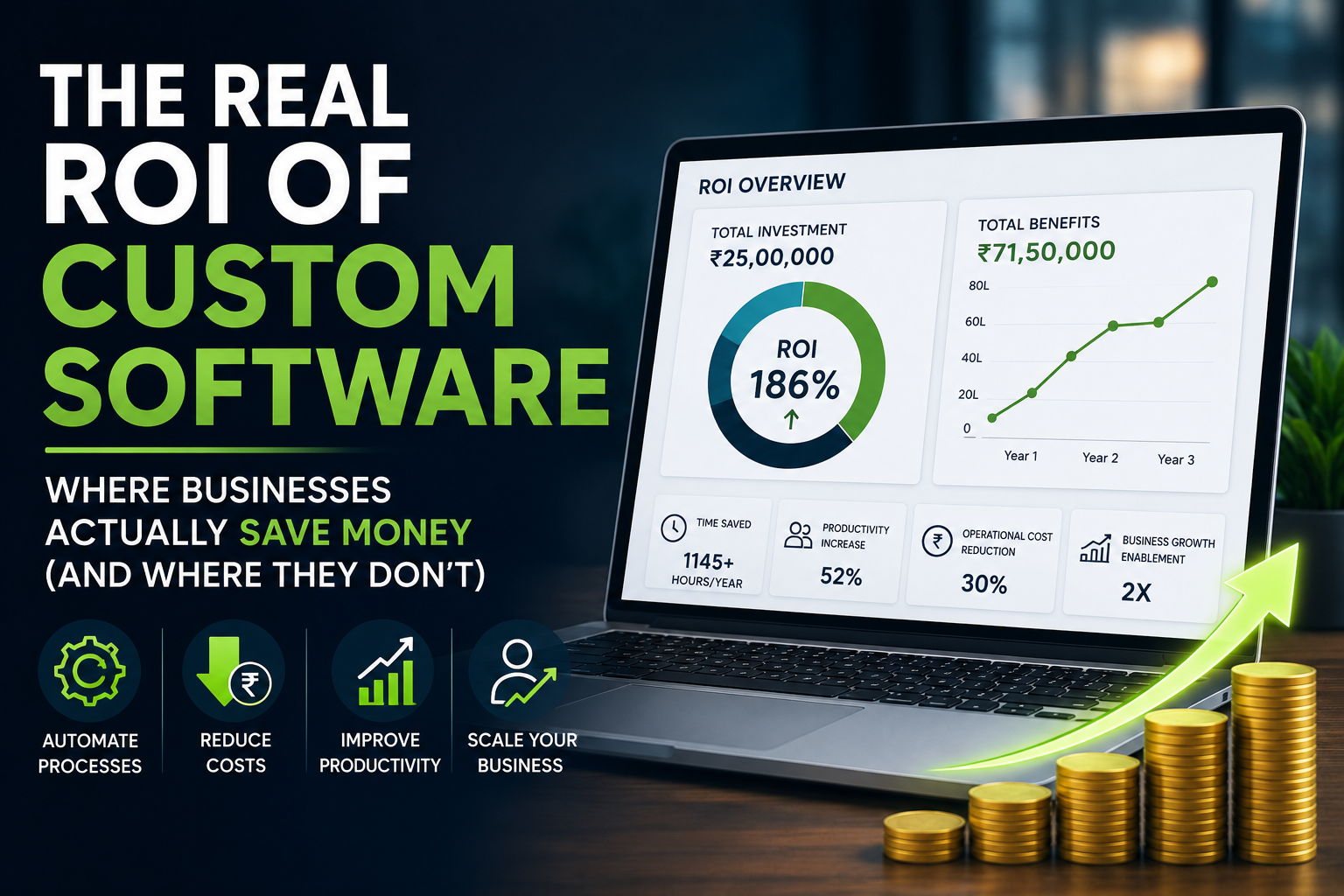
The first spends ₹25 lakhs building a custom ERP platform and, within two years, cuts operational costs by 30%, reduces manual work by half, and supports twice as many customers without hiring additional administrative staff.
The second invests a similar amount in a custom application that employees rarely use. Features go unused, timelines slip, and within eighteen months the company starts looking for another software vendor.
Both businesses invested in custom software.
Only one achieved a meaningful return on investment.
The difference wasn’t the technology. It was the business strategy behind it.
After delivering more than 800 software projects across industries, we’ve observed that successful software investments rarely begin with a discussion about programming languages or features. They begin with a simple business question:
“What problem are we solving, and how will we measure success?”
If that question remains unanswered, even the most advanced technology is unlikely to deliver a strong return.
What Does ROI Really Mean in Custom Software?
Many organizations calculate ROI by comparing the cost of development against expected financial savings.
That’s only part of the picture.
This aligns with Gartner’s view that successful digital transformation initiatives focus on measurable business outcomes rather than technology implementation alone.
Where Businesses Actually Save Money
1. Replacing Manual Processes
Many businesses still rely on spreadsheets, emails, and disconnected systems to manage daily operations.
Employees spend hours:
– Copying information between applications
– Preparing recurring reports
– Following up manually with customers
– Updating the same data multiple times
These activities consume time without creating value.
Custom software automates repetitive workflows, allowing teams to focus on decisions, customer relationships, and business growth rather than administrative work. Global research from McKinsey also highlights that organizations achieve the greatest productivity gains when technology investments are paired with redesigned business processes and operational improvements.
The biggest saving isn’t employee salaries—it’s employee time.
2. Reducing Costly Errors
Human errors are expensive. A single incorrect inventory update, duplicate customer record, delayed approval, or invoicing mistake can create operational delays and financial losses. Custom software introduces standardized workflows, automated validations, approval mechanisms, and centralized data, significantly reducing avoidable mistakes. In many organizations, preventing errors generates a higher return than reducing labour costs.
3. Eliminating System Silos
One department uses Excel.
Sales uses a CRM.
Finance works with accounting software.
Operations maintain separate records.
When systems don’t communicate, employees become the bridge between them.
That means duplicate work, inconsistent information, and slower decision-making.
Integrating business systems through custom software reduces these inefficiencies and creates a single source of truth across the organization.
4. Supporting Growth Without Linear Hiring
Growth usually increases complexity.
More customers bring more orders, approvals, reports, support requests, and operational coordination.
Businesses that rely entirely on manual processes often need to expand administrative teams as they grow.
Well-designed custom software changes that equation.
Instead of adding people to manage higher volumes, organizations improve efficiency through automation, enabling sustainable growth with lower operational overhead.
Where Businesses Don’t Save Money
One of the biggest misconceptions in technology is that every problem requires custom software.
It doesn’t.
For mature business functions such as email marketing, accounting, payroll, video conferencing, or team collaboration, established SaaS platforms often provide better value than building a custom solution.
The real question isn’t:
Can we build it?
The better question is:
Should we build it?
A responsible technology partner should be willing to recommend existing solutions when they deliver better business outcomes.
The Hidden ROI That Rarely Appears in Financial Reports
Some of the most valuable benefits of custom software aren’t immediately visible on a balance sheet.
Consider the impact of:
– Faster decision-making through real-time dashboards
– Better collaboration across departments
– Improved compliance and audit readiness
– Consistent customer experiences
– Greater visibility into business performance
– Reduced dependency on individual employees
These advantages may not have an immediate monetary value, but they significantly improve an organization’s ability to compete and adapt.
Before You Invest: Five Questions Every Business Should Ask
Before approving any software budget, ask:
1. Which business process consumes the most time every week?
2. Where are mistakes most frequently occurring?
3. Are employees duplicating work across multiple systems?
4. Will automation improve customer experience or internal efficiency?
5. Can existing software solve this problem, or is a custom solution truly required?
If you cannot answer these questions clearly, the priority shouldn’t be software development—it should be business discovery.
The INFOCRATS Perspective
Technology should never be the starting point. Business objectives should.
At INFOCRATS, every engagement begins with understanding how the organization operates, where inefficiencies exist, and what measurable outcomes define success.
In some cases, the right recommendation is custom software.
In others, it may be integrating existing platforms, modernizing legacy systems, or improving current workflows.
The goal isn’t to build more software. The goal is to create greater business value. That philosophy has guided more than 800 successful software projects over nearly three decades.
Final Thoughts
Custom software is not an expense—it is a strategic investment.
Its value isn’t measured by the number of features delivered or the technologies used. It is measured by the business outcomes it creates: lower operational costs, improved efficiency, stronger customer experiences, and the ability to scale with confidence.
The organizations that achieve the highest ROI don’t necessarily spend the most on technology. They invest in solving the right problems, define success before development begins, and choose partners who understand both technology and business.
Because in the end, the best software doesn’t just automate work—it helps businesses make better decisions, serve customers more effectively, and grow with greater confidence.
Leave a Reply