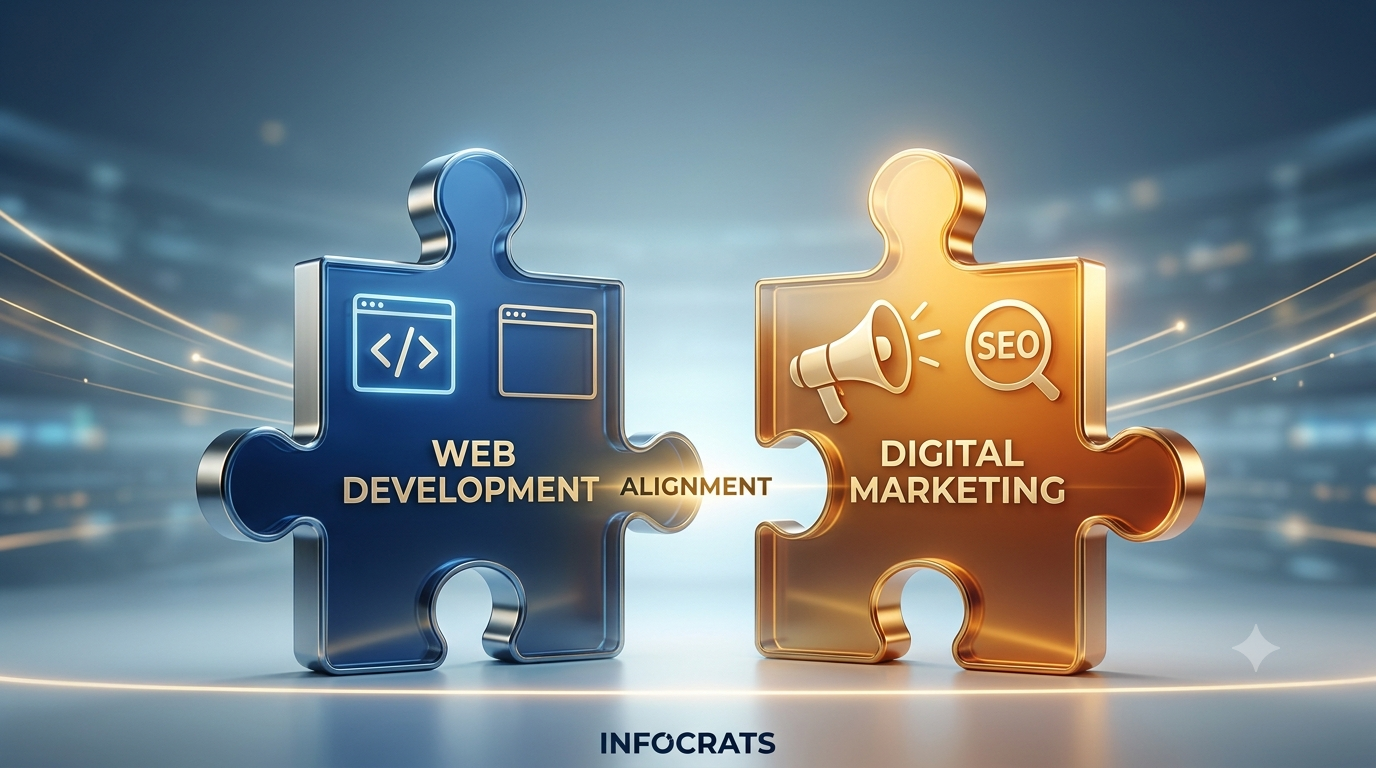
A business can have a good-looking website, an active social media page, and a well-planned advertising campaign yet still struggle to get good results. The problem is often not with any one part of the strategy. It is the disconnect between them.
Think of your website as the place where people decide what to do. Digital marketing brings people to your website. Your website determines what happens after that. If these two elements are planned separately, businesses may waste money on attracting visitors who do not stay, ask questions, or buy anything.
This is why businesses need to think beyond having a website or doing digital marketing. The real opportunity is in making both work together.
Website Is More Than an Online Brochure
For businesses, the website is still just a digital visiting card. It has information about the company, its services, contact details, and maybe some photographs.
That approach used to work when people were just looking for information. Now visitors expect more.
When someone discovers your business through Google, media, an advertisement, or a recommendation and they visit your website, they start evaluating your business right away. They ask themselves if the information is easy to understand. Does the company seem trustworthy? Is the website easy to navigate? Can they find what they need quickly?
A developed website answers these questions naturally.
This is where choosing the right development partner matters. A business looking for the best web development company in Indore should look beyond how the website looks and consider how it works, if it can grow with the business, if it works well on mobile devices, and if it provides a good user experience.
Your website should not just look good when it is launched. It should be able to support your business as your products, customers, and marketing activities change.
Marketing Can Bring Visitors. Your Website Has to Convert Them
Imagine spending money on a Google campaign that brings hundreds of visitors to your website every month. If those visitors find a website with outdated information or no clear next step, the campaign may bring traffic but not enough business.
This is one of the reasons website development and marketing cannot exist in isolation.
A digital marketing strategy may focus on attracting the audience through SEO, paid advertising, social media, or content. Once someone reaches your website, the responsibility shifts to the overall digital experience.
The landing page should match the message that attracted the visitor. The content should answer their questions. The navigation should make sense. Contact forms should be simple. Calls to action should appear at the right moments.
In other words, marketing creates the opportunity, while your website helps convert that opportunity.
SEO Should Influence Website Development From the Beginning
Search engine optimization is often thought of as something that happens after a website is built. Many SEO considerations can be addressed during development.
Website structure, page speed, mobile responsiveness, URLs, internal linking, content organization, metadata, and technical performance can all influence how well your website performs in search.
For example, creating a page for each important service can make it easier to communicate precisely what your business offers. Clear navigation can help users and search engines understand the relationship between pages.
This is also why businesses searching for a marketing company in Indore should consider whether the agency understands the website behind the marketing campaign.
SEO is not just about adding keywords to articles. It is about creating an ecosystem where useful content, technical performance, user experience, and search visibility support each other.
Good Design Should Have a Purpose
There is nothing wrong with wanting a visually impressive website. Good design can make a first impression.
Design should solve problems rather than just look good.
A visitor should be able to understand the purpose of a page without having to figure it out. Important information should be easy to find. Buttons should look like they can be clicked. Text should be easy to read. Forms should not feel too complicated.
The best websites often do not feel complicated to use. That simplicity is usually the result of planning.
User experience needs to be considered alongside development. When designers, developers, and marketing teams work toward the goals, the final website is more likely to serve both the business and its customers.
Content and Technology Need to Move
A common mistake is to finish the website first and think about content later.
Content is not an afterthought. It is one of the reasons people visit a website.
Service pages, blogs, case studies, FAQs, product information, guides, and other resources help visitors understand a business. They can also create opportunities to appear for search queries.
At the time, content needed the right technical environment. Your website should make it easy to publish pages, update existing information, add images, manage forms, and support future marketing campaigns.
This becomes especially important for growing businesses. The website you need today may be very different from the website you need two or three years from now.
What Businesses Should Look for in a Digital Partner
Whether a company is building its website or redesigning an existing one, it is worth looking at the complete picture before choosing a technology partner.
Of asking only “Can they build a website?” businesses should ask:
* Can they understand our business objectives?
* Can they build for users?
* Can the platform support growth?
* Do they understand SEO and digital marketing?
* Can they integrate the website with business systems?
* Will the website be easy to maintain and update?
* Can they provide support after launch?
These questions shift the conversation from short-term development to long-term digital growth.
For businesses evaluating the best web development company in Indore, this broader perspective can make the selection process much more meaningful. Similarly, when choosing a marketing company in Indore, it makes sense to evaluate how well the agency understands websites, content, user journeys, and conversion. Not just advertising or rankings.
The Digital Experience Is One Connected Journey
Customers do not think in terms of departments. They do not separate your SEO strategy from your website design or your social media campaign from your landing page. They simply experience the brand as one journey.
They might see an Instagram post, search for your company on Google, visit your website, read a service page, check a review, and finally fill out a contact form. Every one of these interactions contributes to their perception of your business.
That is why digital strategy works best when different pieces are planned together.
A strong website gives marketing campaigns a foundation. Good marketing sends visitors to the right pages. Useful content builds trust. Thoughtful design makes information easier to consume. Technical performance keeps the experience smooth.
Together, these elements can turn a collection of activities into a meaningful business asset.
For companies that want to build this kind of connected presence, INFOCRATS brings together web development, custom software development, mobile applications, web applications, web design, and digital marketing under one technology ecosystem. The company has been operating since 1996. Is based in Indore.
The bigger lesson, however, applies to every modern business: your website and your marketing strategy should never have to work separately. When they are designed to support each other, every digital interaction has a chance of moving a potential customer one step closer to choosing your business.